Author of 84 Claude Code skills.
Building agents + dev tools for AI engineers.
The model isn't the binding constraint anymore — the harness around it is. I build at that layer: decision-first skills, persistent agent infrastructure, eval-driven shipping, named-with-receipts content. Open-source, opinionated, current to 2026.
JacksonBuildsAI/ai-skills
A Claude Code plugin marketplace. 84 production-pattern skills covering RAG, evals, agents, MCP, fine-tuning, observability, security, multimodal, voice. Each skill is a 200-300 line decision document with named tools, prices, regulations.
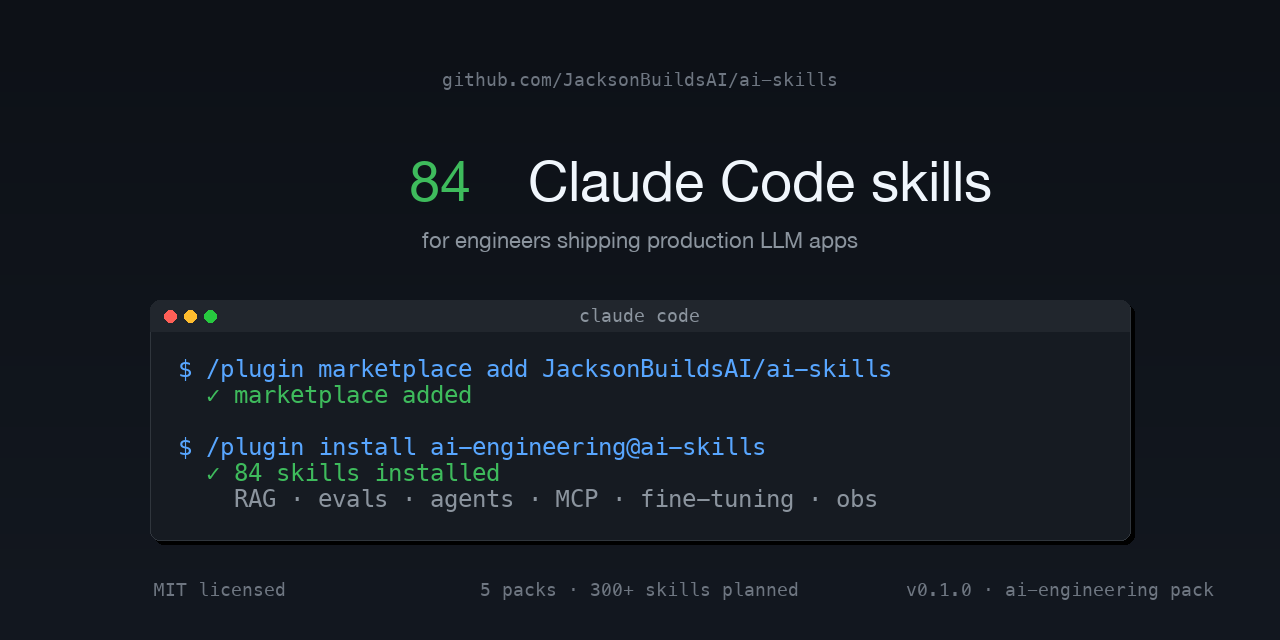
84 production-pattern skills, plug-and-play
/plugin marketplace add JacksonBuildsAI/ai-skills
/plugin install ai-engineering@ai-skills
The harness layer is undervalued.
"The model isn't the binding constraint anymore.
The harness around it is."
- Better operators ship more than better models do, given the same model. Karpathy's "skill issue" thesis (March 2026) named the thing — the human in the loop is the bottleneck, not GPT-6.
- The harness layer compounds. Agent files, persistent memory, locked eval surfaces, git-revert ratchets — these are infrastructure investments that pay off across every model upgrade.
- Decision-first beats template-first. Most "AI skill libraries" are prompt collections. The ones worth installing tell you when NOT to use a pattern.
- Editorial bar, not aggregational. Rewrite or replace, never reproduce. Surface area shrinks; signal-to-noise improves.
- Decade of agents, not year of agents. Build for sustained orchestration, not single-shot demos.
Long-form posts & analyses.
Cross-posted from LinkedIn. The Karpathy series, the X-Men agent-architecture series, and ad-hoc takes on industry news as it lands.
Anthropic × xAI: 300MW + doubled rate limits + "dreaming" — what changed for builders
Most AI agents are just civilians in spandex. Here's how to mutate them.
Open-sourced 84 Claude Code skills for shipping production LLM apps
Software 3.0 — what every AI builder should internalize
Always up for harness-thinking conversations.
Open to collaborations, deeper feedback on the library, or talking about agent architecture, eval-driven shipping, and developer-tool design at AI labs.